
 Facebook
 X
 Pinterest
 Copy Link
Aloha friends,
Leasehold vs. fee simple in Hawaiʻi trips up a lot of buyers. If you’ve been browsing Oʻahu condos, you’ve probably seen a price that looked surprisingly low, with “leasehold” in the listing details. It’s one of the biggest differences between buying here and buying on the mainland. Here’s a plain guide to what leasehold means, what happens when the lease runs out, how it affects your loan, and what to check before you make an offer.
Key takeaways
- Fee simple: you own the land and the home. Leasehold: you own the right to use the property until the land lease ends.
- Lease rent is usually fixed for a set period, then renegotiated, and it can go up a lot.
- When the lease ends, many leases require owners to hand the unit back to the landowner. Extensions and land purchases happen, but neither is guaranteed.
- Loans need lease time left after the loan ends: 14 years for VA, 10 for FHA and 5 for Fannie Mae.
This is general information, not legal or lending advice. Every lease is different, so have a real estate attorney review it before you commit.
What you own: fee simple vs. leasehold
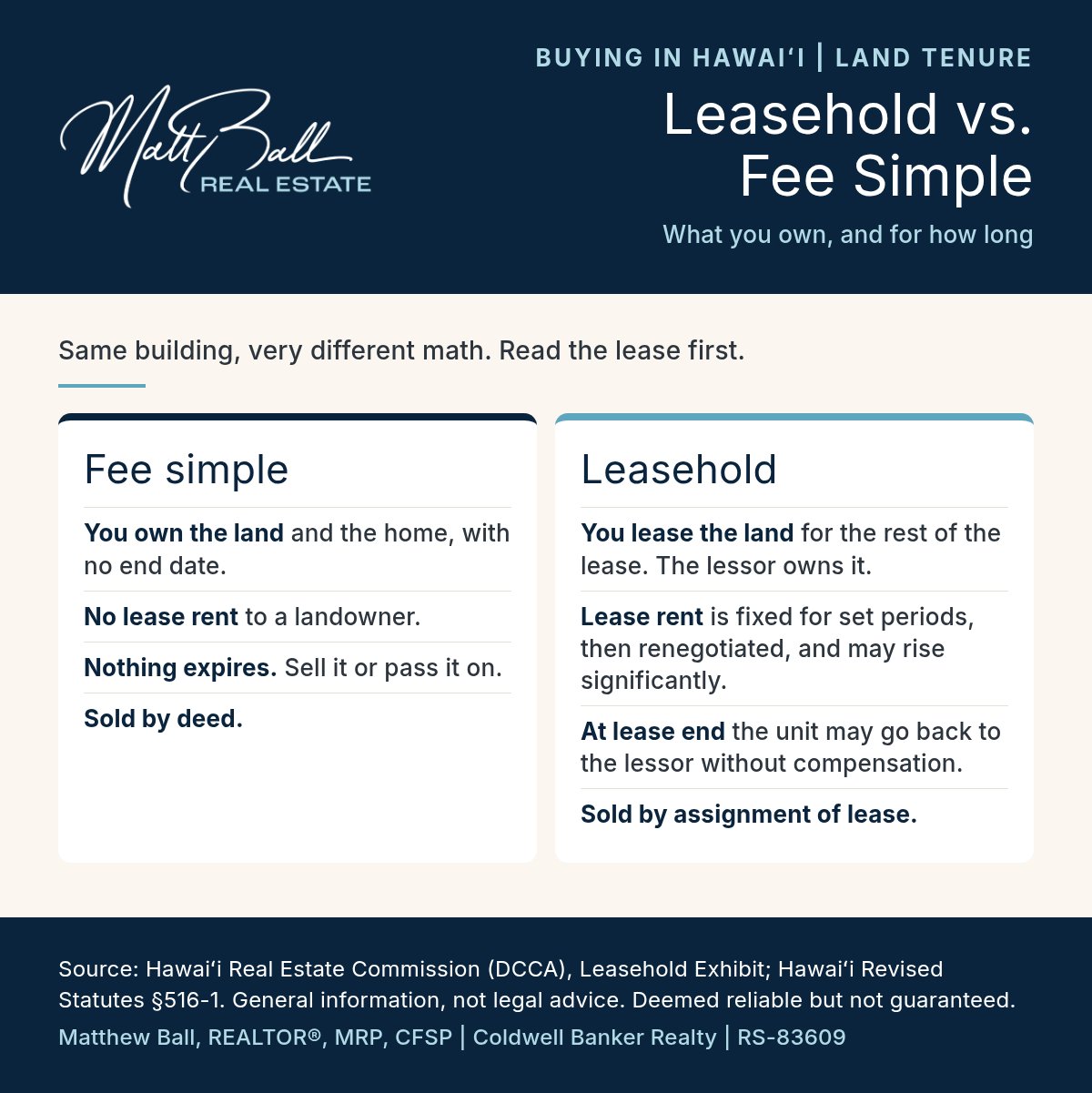
Fee simple is what most mainland buyers think of as owning a home. You own the land and the home, there’s no land rent, and nothing expires. Hawaiʻi law calls it “absolute ownership of land for an indefinite duration, freely transferable and inheritable.”
Leasehold means you own the right to use the property for the rest of a land lease, not the land itself. The landowner (the lessor) keeps the land, and you pay lease rent and follow the lease. The state’s leasehold disclosure from the Hawaiʻi Real Estate Commission puts it simply: the buyer “will not acquire outright or absolute fee simple ownership of the land.”
Three terms you’ll hear:
- Leased fee: the landowner’s interest. “The leased fee is available” means the land may be for sale.
- Assignment of lease: how leasehold is usually transferred, instead of a deed.
- Sublease: in some buildings, the developer leased the land under a master lease and subleased it to each owner. That matters for FHA loans.
Why Hawaiʻi has leasehold, and where you’ll see it
It’s history. In the Land Reform Act of 1967, the Legislature found that a few large landowners held much of the land and preferred to lease it rather than sell it. The U.S. Supreme Court, upholding that law in Hawaii Housing Authority v. Midkiff (1984), recounted the Legislature’s finding that on Oʻahu, 22 landowners owned 72.5% of the fee simple titles.
Many single-family homeowners have since bought the land under their homes. According to the state’s Department of Business, Economic Development and Tourism (DBEDT), owner-occupied leasehold properties statewide fell from 24,599 in 1993 to 4,172 in 2024. Oʻahu had about 76% of the state’s owner-occupied leasehold units in 2023, and DBEDT notes that most buildings that started out leasehold have converted many of their units to fee simple, mostly in the area between Waikīkī and Kaimukī.
So on Oʻahu, you’ll mostly see leasehold on condos in Waikīkī and urban Honolulu. Two units in the same building can have different tenure, so check the unit, not just the building.
Why leasehold usually costs less
You’re buying a right to use the property for a set time, not the land. In exchange for the lower price, you pay lease rent on top of your maintenance fee, the rent can be renegotiated, and the lease gets shorter every year.
For context, the median Oʻahu condo sold for $499,000 in October 2026, per the Honolulu Board of REALTORS®. That number blends every condo, so it isn’t a fair yardstick for a leasehold unit. Compare a leasehold unit with recent leasehold sales that have a similar number of years left.
How lease rent works
Lease rent is what you pay the landowner for the land. The state’s disclosure explains that it’s “usually fixed at specific amounts for fixed periods of time, and are then subject to renegotiation,” and that renegotiated rents “may increase significantly.” Hawaiʻi law adds a few guardrails:
- Condos: residential leases must provide for mandatory arbitration of rent renegotiation. If a lease doesn’t, the law sets up a panel of three impartial real estate appraisers.
- Single-family lots: renegotiation can’t happen more than once every 15 years, and the new rent is capped by a formula in the statute.
The practical question: what is the rent today, when does it change next, and how will the new number be set?
What happens when the lease runs out
It depends on the lease. These are the usual paths.
Surrender to the landowner
Many leases have a surrender clause. The state’s disclosure says leases “usually require” owners to deliver the unit “and all improvements, including improvements paid for by the lessee” to the landowner at the end, and owners “may have to surrender” them “without any compensation.” The kitchen you remodeled stays with the property.
An extension or new lease
Sometimes the landowner and owners agree to extend the lease, usually with new lease rent. It’s a negotiation, not a right.
Buying the land
Sometimes the landowner offers to sell the land. Hawaiʻi’s lease-to-fee law for condos, HRS Chapter 514C, sets ground rules:
- The association gets first right to buy if the land is sold to someone else, at the same price.
- An association purchase needs 67% approval from owners (by common interest). The association can borrow and assess owners to pay for it, then sell each owner the land under their unit. No owner is forced to buy in.
- Individual offers come with time to decide: at least 90 days, plus a 90-day window to cancel a purchase contract without penalty.
What the law doesn’t do today is force a sale. Honolulu’s mandatory condo conversion ordinance was repealed in 2005, and leasehold condo buyers must be told there is no law for mandatory conversion and “no assurances that such measures will be enacted in the future.”
Why value tends to drop as the lease shortens
Each year you have one less year of use, and the next rent change or the end of the lease gets closer. Loans need a minimum number of years left (below), so once a lease gets too short, fewer buyers can finance it. There’s no reliable formula for how much value changes, so look at recent sales with similar years left.
Financing a leasehold: VA, FHA and conventional
Lenders care about how much lease is left after your loan would be paid off:
- VA: the lease must run, or be renewable at your option, at least 14 years past the loan’s maturity. VA’s legal staff also has to approve the leasehold before the appraisal’s notice of value is issued, and condos need a VA-approved project.
- FHA: a renewable lease of at least 99 years, or at least 10 years past the loan’s maturity. Subleases aren’t eligible.
- Fannie Mae (conventional): at least 5 years past the loan’s maturity, plus other lease rules.
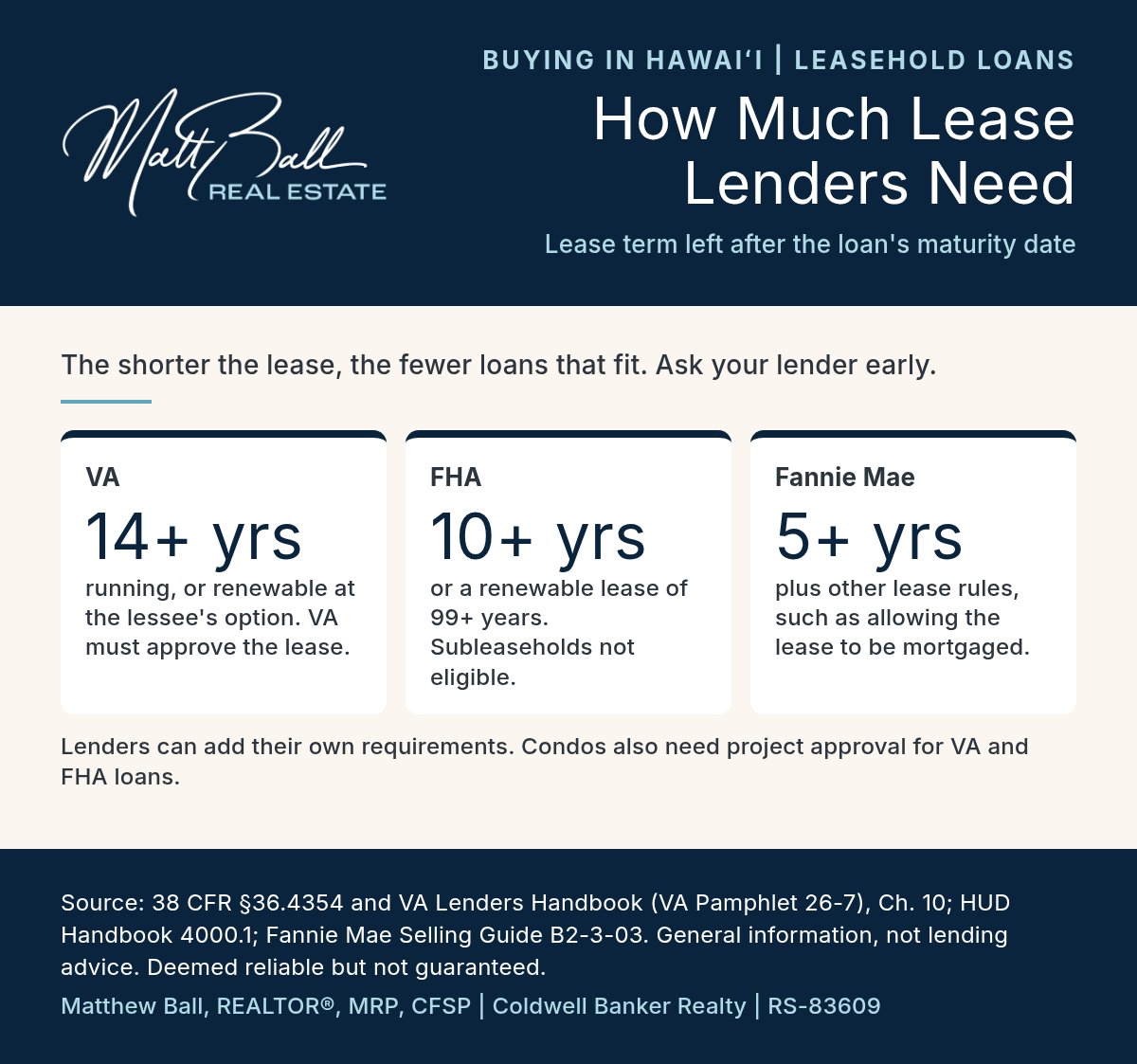
On a 30-year loan, the math works out to about 44 years left on the lease for VA, 40 for FHA (unless it’s a renewable 99-year lease) and 35 for Fannie Mae. Lenders can add their own rules, so ask your lender to review the actual lease before your deadlines start. If you’re on PCS orders, my PCS and VA home buying guide covers the VA side.
What to check in the documents
On a resale, Hawaiʻi law (HRS §516D-11) gives you the lease documents within 10 calendar days after your contract is accepted, then 10 calendar days to review, accept or reject them. You’ll also sign a plain-language summary of the lease. The parties can agree on a standard form to change those time periods, so watch the dates in your contract.
When the documents arrive, look for:
- The lease expiration date
- The lease rent schedule, the next renegotiation date and how new rent is set
- The surrender clause
- Whether you’d hold a lease or a sublease, and what happens if the master lease ends early
- Fee purchase status: any offer from the landowner, association vote, price, loan or special assessment (check the budget, reserves and board minutes)
- The preliminary title report, which should show the lease and prior assignments
- The usual condo documents, covered in my guide to buying a condo on Oʻahu
Questions to ask before you make an offer
- Is this unit fee simple or leasehold, and is it a lease or a sublease?
- When does the lease end, and how many years will be left when my loan ends?
- What’s the lease rent now, and when and how will it change?
- What does the surrender clause require?
- Has the land been offered for sale, or has the association voted on buying it?
- Will my lender finance this lease, and has VA approved it if I’m using a VA loan?
- What have similar leasehold units sold for, with similar years left?
- Has a real estate attorney reviewed the lease?
What this could mean for you
If you’re PCSing to Oʻahu or using a VA loan: confirm early that the lease is long enough and that VA will approve it. Allow time for VA’s review.
If you’re buying your first home: a leasehold’s lower price can look appealing. Add the lease rent to your monthly budget and make sure the lease outlasts your plans.
If you’re downsizing or planning an estate: a lease that ends during your heirs’ lifetime affects what they inherit. Talk it through with your attorney.
If you’re an investor: factor rent renegotiation and the shrinking term into your numbers, and price your exit with the years that will be left.
Frequently asked questions
What is the difference between leasehold and fee simple in Hawaiʻi?
With fee simple, you own the land and the home with no end date. With leasehold, you own the right to use the property until the land lease ends, the landowner keeps the land, and you pay lease rent.
What happens when a leasehold lease expires in Hawaiʻi?
It depends on the lease. Many leases require owners to hand the unit and all improvements back to the landowner without compensation. Sometimes the lease is extended or the land is offered for sale, but neither is guaranteed.
Can I buy the land under my leasehold condo?
Only if the landowner decides to sell. Under HRS Chapter 514C, the association has the first right to buy if the land is sold to someone else, and an association purchase needs 67% owner approval. Individual owners offered the land get at least 90 days to decide.
Can I use a VA or FHA loan on a leasehold property?
Often, if the lease qualifies. VA requires at least 14 years past the loan’s maturity and must approve the lease. FHA requires a renewable 99-year lease or at least 10 years past maturity, and subleases aren’t eligible. Fannie Mae requires at least 5 years.
Will leasehold condos in Hawaiʻi be converted to fee simple?
Not by force under current law. Honolulu repealed its mandatory conversion ordinance in 2005, and buyers must be told there’s no law for mandatory conversion. Voluntary sales of the land still happen.
Looking at a leasehold listing? Send it my way. I’ll help you pull the lease details, compare similar sales and line up the right questions. I can also refer you to real estate attorneys and lenders I trust who know Hawaiʻi leases, and you choose who to hire. We can start with a buyer meeting, or just talk story.
Tools to help you plan
Free guides and calculators on my site. No sign-up needed.
- Buying a Condo on Oʻahu: maintenance fees, reserves and the documents to read.
- Moving to Hawaiʻi: the relocation hub and FAQ, including what leasehold means.
- Rent vs. Buy Calculator: run your own numbers with a rate from your lender’s quote, and add the lease rent.
- PCS and VA Home Buying Guide: for service members on orders to Oʻahu.
- Homes for Sale on Oʻahu: search current listings around the island.
- Buying & Selling Tips: step-by-step guidance for buyers and sellers.
Mahalo,
Matt
Sources: Hawaiʻi Real Estate Commission (DCCA), Leasehold Exhibit; Hawaiʻi Revised Statutes §516-1, §516-83, §514C-2, §514C-6, §514C-6.5, §514C-22, §516D-11, §516D-12 and §519-2; Hawaii Housing Authority v. Midkiff, 467 U.S. 229 (1984); Ching Young v. City and County of Honolulu (9th Cir. 2011); Hawaiʻi DBEDT, Hawaiʻi property ownership: its history and potential future implications (February 2025); 38 CFR §36.4354 and the VA Lenders Handbook, Chapter 10; HUD Handbook 4000.1; Fannie Mae Selling Guide B2-3-03; Honolulu Board of REALTORS®, October 2026 Oahu Monthly Statistical Report (HiCentral MLS data). Laws and loan rules change, so confirm current rules with your attorney and lender. Information is deemed reliable but not guaranteed and is general information, not legal, tax or lending advice.
Matthew Ball, REALTOR®, MRP, CFSP, Coldwell Banker Realty, Licensed in Hawaiʻi, RS-83609
