
Home / Moving to Hawaiʻi / Honolulu Town
Oʻahu area guide
Living in Honolulu Town
When buyers say they want to live "in town," they usually mean some mix of Kakaʻako, Mānoa, Makiki, and Waikīkī: high-rise condos near the water, and houses up in the valleys near the university. I guide families through that choice across Oʻahu, including this urban core, where most of the sales are condos and the single-family inventory is limited.
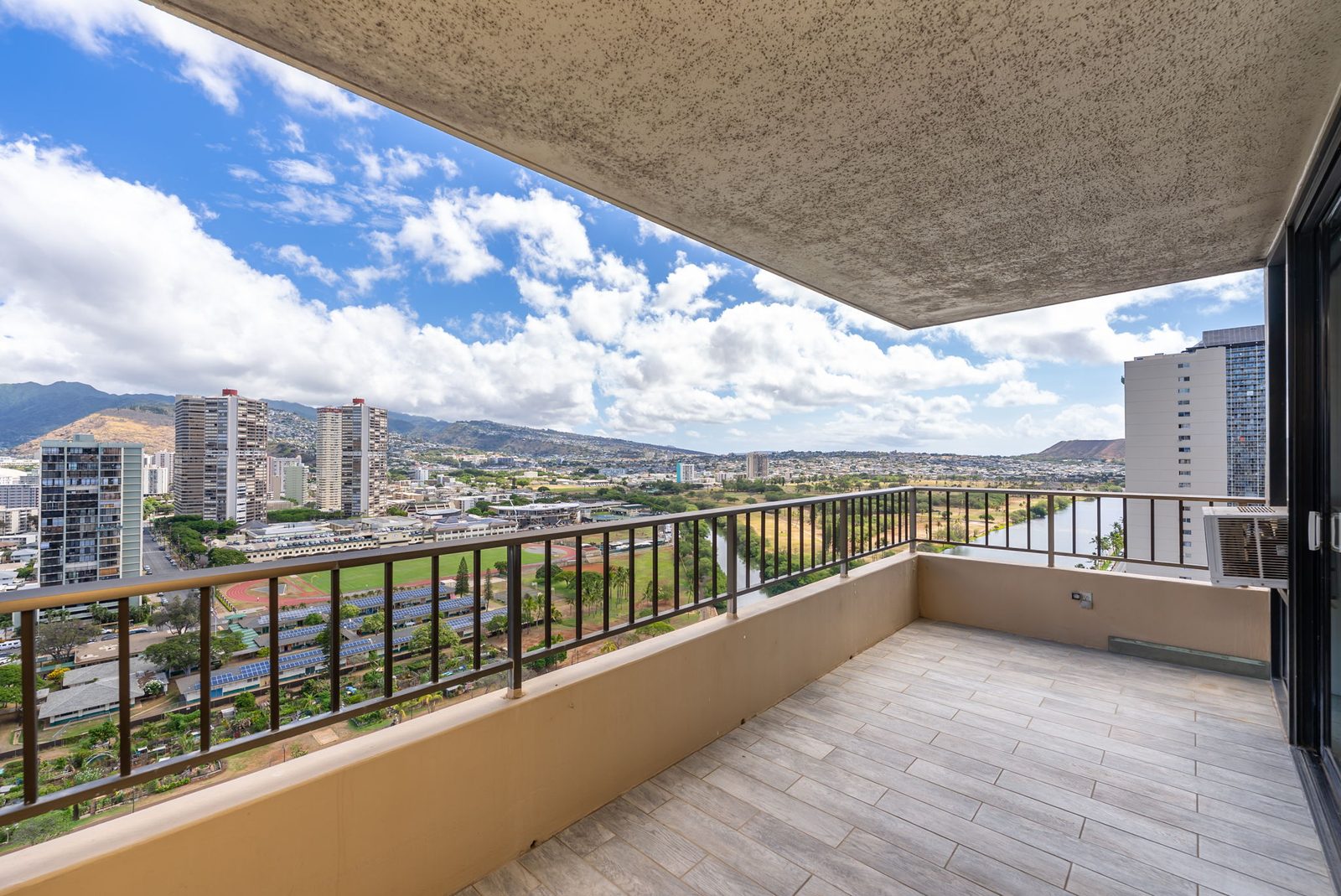
The tradeoff is a shorter trip to Fort Shafter, Tripler, or Pearl Harbor-Hickam, and a very different daily rhythm than a house on the plain or the Windward side. The market snapshot below shows how sales split by neighborhood, plus the school-day drives from a downtown starting point.
Four parts of town
Kakaʻako is the mixed-use neighborhood between downtown and Ala Moana, with many newer condo towers and Kakaʻako Waterfront Park on the waterfront.
Mānoa is the valley neighborhood above the University of Hawaiʻi at Mānoa, with mostly single-family homes.
Makiki sits between Mānoa and the urban core, with a mix of houses, walk-ups, and condos on the slopes below Punchbowl and Tantalus.
Waikīkī is the oceanfront district east of Ala Moana, made up mostly of condos and visitor-oriented buildings.
The Honolulu Board of REALTORS® does not use the word "Town." Kakaʻako is counted in "Ala Moana - Kakaako." Mānoa and Makiki are counted in "Makiki - Moiliili." Waikīkī is its own area. Downtown and Nuʻuanu are tracked separately and are not folded into the numbers below.
Drive times to the bases
Town is usually the shortest drive to Fort Shafter and Tripler, and a relatively short trip to Pearl Harbor-Hickam. The times below are school-day estimates from the same Google traffic data as my commute planner (a typical Wednesday, rounded to 5 minutes, leaving at 7:00 AM and heading home at 4:30 PM). Real times vary.
The planner uses a single Town pin near downtown Honolulu (by ʻIolani Palace). Mānoa, Makiki, Kakaʻako, and Waikīkī can each be a little shorter or longer than the figures below, so run your exact address.
| Base (main gate) | From Town (to / home) |
|---|---|
| Pearl Harbor-Hickam | 15 / 30 min |
| Schofield / Wheeler | 35 / 45 min |
| MCB Kaneohe Bay | 25 / 30 min |
| Fort Shafter | 10 / 25 min |
| Tripler | 15 / 25 min |
| Camp Smith | 20 / 35 min |
A Waikīkī condo and a Mānoa house will not have the same drive, so use the commute planner on my PCS page with the actual address. Open the commute planner
Getting around
The rail (called Skyline) does not yet have a station in Kakaʻako, Mānoa, Makiki, or Waikīkī. The current end of the line is Kahauiki (Kalihi Transit Center), which has a park-and-ride. Nearby stations on the airport side include Lelepaua (Daniel K. Inouye International Airport) and Āhua (Lagoon Drive). TheBus connects from those stations toward downtown, Ala Moana, UH Mānoa, and Waikīkī. Inside town, TheBus and walking cover a lot of daily trips that would be a drive in other parts of the island.
Schools
This part of Honolulu is mostly in the HIDOE Kaimukī-McKinley-Roosevelt complex area. Public high schools here include President Theodore Roosevelt High School (the Roosevelt complex includes Mānoa Elementary and Noelani Elementary), President William McKinley High School, and Kaimukī High School (whose stated school boundaries include Waikīkī). Exact assignment still depends on the street. Your assigned school depends on your exact address, so check the HIDOE school finder (opens in a new tab) and confirm with the school directly. HIDOE notes its locator is for reference only.
Parks
A few parks to know: Kakaʻako Waterfront Park and Ala Moana Regional Park near Kakaʻako; Mānoa Valley District Park in Mānoa; Makiki District Park in Makiki; and Kapiʻolani Regional Park on the Waikīkī side of Lēʻahi (Diamond Head).
What homes are selling for
Because HBR splits Town into several areas, the figures below are listed that way on purpose.
Common questions
Does Town actually shorten the drive to base?
To Fort Shafter, Tripler, and Pearl Harbor-Hickam, often yes. A school-day drive from the Town pin to Fort Shafter is about 10 minutes at 7:00 AM, and about 15 minutes to Pearl Harbor-Hickam. The drive to Schofield / Wheeler is a different commute: about 35 minutes in the morning and 45 minutes heading home. In the condo market, building rules, parking, and VA project approval matter as much as the drive, so those are worth checking early.
How do Kakaʻako, Mānoa, Makiki, and Waikīkī differ?
Kakaʻako and Waikīkī are largely condo districts near the water, and Waikīkī has the larger condo inventory. Mānoa is a valley of mostly houses, near the university. Makiki sits in between, with a mix of houses and condos. They are close together on the map, but the housing types and price points are not the same.
Does the rail go through Kakaʻako or Waikīkī yet?
Not yet. There is no station in Kakaʻako, Mānoa, Makiki, or Waikīkī. The rail currently ends at Kahauiki (Kalihi Transit Center), which has a park-and-ride. TheBus connects from Kahauiki and Āhua (Lagoon Drive) toward downtown, Ala Moana, UH Mānoa, and Waikīkī.
What have Town condos and houses been selling for?
The year-to-date condo and single-family figures for Ala Moana - Kakaako, Makiki - Moiliili, and Waikīkī are in the market snapshot above. Small-sample notes are flagged there too.

Let's talk story
If you're weighing a Kakaʻako or Waikīkī condo against a house in Mānoa or Makiki, I can help you compare the building rules, the parking, the school assignment, and the real drive to work.
Matthew Ball, REALTOR® | RS-83609 | Coldwell Banker Realty | 808-256-5039 | matt@mattballrealestate.com
